
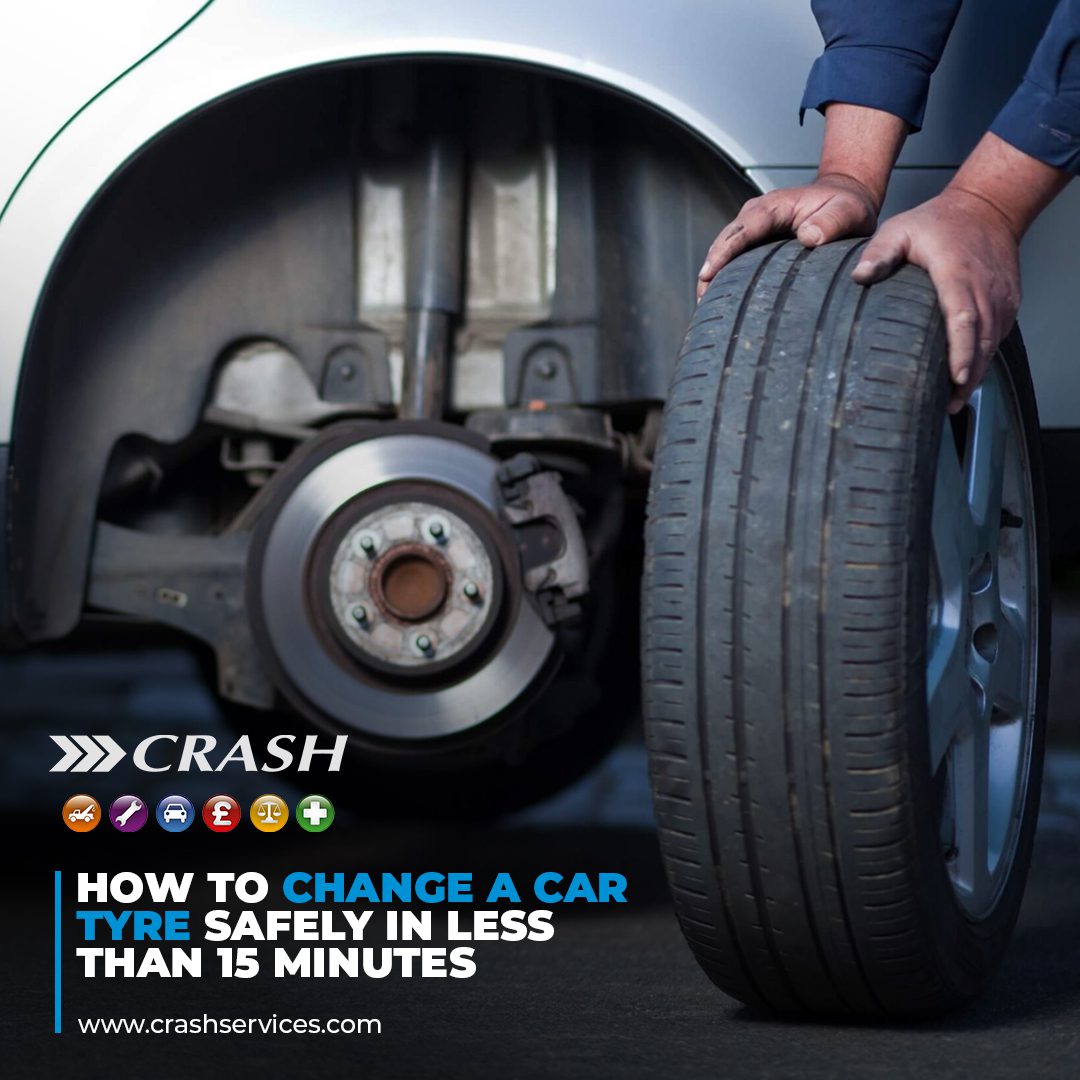
How to Change a Car Tyre
A flat tyre can happen when you least expect it, but it doesn’t have to ruin your day. With the right equipment and a little preparation, you can safely change a tyre and get back on the road in under 15 minutes.
At Granite Breakdown, a division of CRASH Services, tyre-related issues are among the most common reasons for roadside callouts. From punctures and damaged sidewalls to slow punctures caused by valve leaks, flat tyres can occur at any time and in any season.
Fortunately, with these practical tips from Granite Breakdown’s Stephen Savage, you’ll know exactly what to do if a flat tyre leaves you stranded.
Common Causes of Flat Tyres
Flat tyres can be caused by a variety of factors, including:
- Punctures from nails, screws, or sharp objects
- Under-inflated tyres
- Over-inflated tyres
- Damaged valve stems
- Tyre bead leaks
- Poor road surfaces and potholes
- General tyre wear and tear
Regular tyre maintenance can help reduce the likelihood of unexpected punctures and breakdowns.
Safety First
Before attempting to change your tyre, make sure you and your passengers are safe.
Stephen advises:
“Make sure you’re safely pulled in on the hard shoulder or as far off the road as possible before attempting to change your tyre.
Put your hazard lights on to alert other motorists so that they can slow down and if necessary, prepare to move around your car.”
If you have a reflective jacket, put it on before exiting the vehicle. If you carry a warning triangle, place it in accordance with road safety guidance where it is safe to do so.
Locate Your Spare Tyre
Most vehicles are equipped with either:
- A full-size spare wheel, or
- A space-saver spare wheel
Many newer vehicles now include space-saver wheels to reduce vehicle weight and improve fuel economy.
Stephen explains:
“With car manufacturers cutting costs and trying to increase a car’s miles per gallon, space savers are increasingly common.
There should be a sticker on your space saver tyre which recommends the speed you can drive with it fitted but as a general safety tip, drive no faster than 30MPH.”
Remember, a space-saver spare is designed as a temporary solution and should be replaced with a full repair as soon as possible.
Equipment You’ll Need
Before starting, gather the necessary equipment:
- Vehicle jack
- Wheel wrench
- Spare wheel or tyre
- Wheel nut key (if locking wheel nuts are fitted)
- Wheel chocks (recommended)
Stephen advises:
“You will need a jack for lifting your car off the ground, a wrench for unscrewing the wheel nuts and ideally a wheel chock to stop the vehicle rolling when it’s jacked up.
If your locking nuts are fitted you might also need a wheel nut key.
It’s also a good idea to glance through your car’s handbook; it’s a good reference point on your specific car model and jacking points.”
Additional useful items include:
- Torch
- Gloves
- Tyre pressure gauge
- Reflective jacket
Before You Begin
Before lifting the vehicle:
- Apply the handbrake firmly.
- Turn off the engine.
- Ensure all passengers exit the vehicle and stand safely away from the road.
- Position wheel chocks where appropriate.
Stephen explains:
“Before you start removing the tyre make sure your handbrake is on and if you’ve anyone else in your car, ask them to stand outside in a safe area away from the road and car.”
And adds:
“Position your wheel chocks to make sure your car doesn’t roll when it’s jacked.
Wheel chocks are plastic, rubber or metal safety tools to stop your car rolling and can be bought online or in most motor factor supply shops.”
Step-by-Step Guide to Changing a Tyre
1. Loosen the Wheel Nuts
Before lifting the vehicle:
- Remove any wheel trims or hub caps if fitted.
- Use the wrench to slightly loosen each wheel nut.
- Turn anti-clockwise.
Do not fully remove the nuts at this stage.
2. Locate the Correct Jacking Point
Consult your vehicle handbook for the correct jacking points.
Position the jack securely beneath the recommended lifting location.
3. Raise the Vehicle
Slowly jack the vehicle upwards until the flat tyre is clear of the ground.
Stephen advises:
“About 10-15cm in height should be enough.”
4. Remove the Wheel Nuts
Now fully remove the loosened wheel nuts and place them somewhere safe.
5. Remove the Flat Tyre
Carefully pull the wheel towards you and remove it from the hub.
Stephen explains:
“Using your hands, loosen and remove the wheel nuts and slowly pull the tyre towards your chest until it fully removes.”
6. Fit the Spare Wheel
Mount the spare wheel onto the wheel bolts.
Stephen says:
“Gently, one by one, place and tighten each of the wheel nuts.”
Tighten them enough to hold the wheel securely in place.
7. Lower the Vehicle Slightly
Lower the vehicle until the spare tyre just makes contact with the road surface.
Stephen advises:
“Try and lower the jack just so that the spare tyre now makes contact with the ground.”
8. Fully Tighten the Wheel Nuts
Using the wheel wrench, tighten the nuts securely in a diagonal pattern.
9. Lower the Vehicle Completely
Remove the jack and carry out a final check on all wheel nuts.
Stephen says:
“Check your wheel nuts one last time to ensure they’re tight.”
10. Pack Everything Away
Place the following safely into the boot:
- Flat tyre
- Jack
- Wheel wrench
- Wheel chocks
- Any other equipment used
The difficult part is now over.
After Changing Your Tyre
Before continuing your journey:
- Drive carefully.
- Check the spare tyre pressure when possible.
- Visit a garage as soon as practical.
- Arrange a permanent tyre repair or replacement.
If you’re using a space-saver wheel, observe any speed restrictions marked on the tyre.
Don’t Want the Hassle of Changing a Tyre?
As Stephen Savage from Granite Breakdown says:
“If you don’t want to worry about the hassle of flat tyres in the future, why not take out an annual membership with Granite Breakdown? And we can do it for you!”
More than 20,000 motorists across Northern Ireland trust Granite Breakdown for roadside assistance and recovery.
You can find out more about:
How CRASH Services Can Help You After A Car Crash or Accident
At CRASH Services, we specialise in helping drivers in Belfast, Newry, Derry~Londonderry and across Northern Ireland get back on the road quickly.
After an accident, our expert team will take care of:
- vehicle recovery,
- collision investigation,
- organising repairs,
- providing a replacement vehicle,
- liaising with insurance companies and
- legal and medical
And we do it all, at no cost to the not-at-fault driver.
Our service is free as we recover the costs from the third-party insurers.
Why Choose CRASH Services?
- Established in 1996
- Trusted by Hundreds of Thousands Local Northern Ireland Motorists
- No Cost to You, Costs Recovered from Insurers
- Complete Accident Management from Recovery to Repairs
- 99% Customer Recommendation Rate
Our Mission is Simple:
“To act with care for those involved in road traffic accidents.”
Need Help After an Accident in Belfast, Newry, Derry~Londonderry or anywhere across Northern Ireland?
Call us today on 028 9066 0244 or Request a Callback Today
CRASH Services, take care of everything, at no cost to you!
Frequently Asked Questions
- How do I know if I can safely change a tyre myself?
You should only change a tyre if you can stop in a safe location away from traffic and have the correct equipment. If you feel unsafe, are on a busy road, or are unsure of the process, contact a breakdown provider for assistance.
- What should I do first when I get a flat tyre?
Pull over in a safe location as far from traffic as possible, switch on your hazard lights, apply the handbrake, and ensure all passengers move to a safe place away from the vehicle.
- What equipment do I need to change a tyre?
Most vehicles require:
- A spare wheel or space-saver tyre
- A vehicle jack
- A wheel brace or wrench
- Locking wheel nut key (if fitted)
Helpful extras include:
- Gloves
- Torch
- Reflective jacket
- Wheel chocks
- Tyre pressure gauge
- What is a wheel chock?
A wheel chock is a safety device placed against a tyre to help prevent the vehicle from rolling while it is being lifted by a jack.
- Why should I loosen the wheel nuts before jacking up the car?
Loosening the wheel nuts while the tyre is still in contact with the ground helps prevent the wheel from turning and makes the process safer and easier.
- How do I find the correct jacking points on my vehicle?
Your vehicle handbook will show the approved jacking points. Using the wrong location can damage the vehicle or create a safety risk.
- How high should the car be lifted?
The vehicle only needs to be raised enough for the flat tyre to clear the ground so the replacement wheel can be fitted comfortably.